Author Archives: Martin Stahl

2017 Missouri Open Results
by Randy Merrell

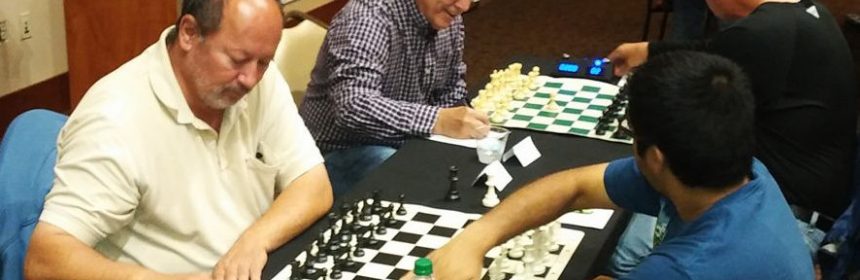
Eighty chess players attended the 2017 Missouri Open Chess Championship held at Unity Village Missouri. Amazingly exactly forty in each section.Thanks to a $500 donated guaranteed first place prize the tournament qualified for the Grand Prix circuit with 6 Grand Prix points. All rounds started within just a few minutes of the advertised time. The Unity Village Hotel was praised as a wonderful venue. The only problem I’m aware of was the proximity of the tables to the air conditioning vents. We eventually found a way to correct the issue.


Open

Boards one and two in the open section held everyone’s attention. In the fourth round a draw with Abhishek Mallela put IM Michael Brooks within reach. Master Ken Jones win over Ron Luther setup the final board one match. However a win by Brooks over Jones, and Ron Luther’s draw with Abhishek Mallela on board two put Brooks over the top for the championship.


Reserve

Ryan Duan dominated the Reserve section. Finishing a half point out front with a perfect 5.0. Because he elected to enter ineligible for prizes 1st place money went to Xueyi Chen. The first Missouri player was Wesley Willis who won the championship plaque and a share of second place with 4.0 score. Losing only to Cael Province who also took part of the 2nd place prize, along with Charles Carlson.


[table caption=”Prizes. Missouri Open 2017: Open]
Pairing Number | Name | Cash | Non-Cash Prize | Prize Credited to Pool
1 | MICHAEL A BROOKS (4.5/2390) | 500 | Plaque | Place: 1 – $500
20 | JONATHA GOLLAPUDI (4.0/1810) | 125 | | U2000/1 – $125
2 | ABHISHEK MALLELA (4.0/2228) | 125 | | Place: 2 – $250
6 | SAMUEL ISA FOWLER (4.0/2091) | 125 | |
30 | BRYCEN M PARKER (3.0/1693) | 100 | | U1800/1 – $100
[/table]

[table caption=”Prizes. Missouri Open 2017: Reserve]
Pairing Number | Name | Cash | Non-Cash Prize | Prize Credited to Pool
13 | XUEYI CHEN (4.5/1450) | 200 | | Place: 1 – $200
8 | CAEL DOU PROVINCE (4.0/1491) | 34 | | Place: 2 – $100
7 | WESLEY DAL WILLIS (4.0/1506) | 34 | Plaque |
10 | CHARLES W CARLSON (4.0/1472) |34 | |
18 | KEN WEST (3.0/1200) | 100 | | Class D/1 – $100
20 | ACHILLES B MILLER (3.0/1158) | 34 | | Class E/1 – $100
19 | CELINA ZHOU (3.0/1183) | 34 | |
29 | THOMAS WEI (3.0/1036) | 34 | |
38 | CRAIG A GUSTAFSON (2.5/0) | 100 | |U1000-Unr/1 – $100
[/table]

USCF Tournament Crosstable (link)

Here are some games from the event:

Round 4: NM Kenneth Jones (annotator) vs NM Ron Luther

[ctpgn layout=”left” id=”2017_MO_Open_JonesVsLuther”][Event “2017 Missouri Open”]
[Site “?”]
[Date “2017.08.06”]
[Round “4”]
[White “Jones, Kenneth E”]
[Black “Luther, Ronald”]
[Result “1-0”]
[WhiteElo “2193”]
[BlackElo “2225”]
[ECO “B07”]
[EventDate “2017.??.??”]
[PlyCount “71”]{(As my record against strong competition had not been good lately, before
the game I decided to concentrate on making good decisions and let that
take me where it would.)}
1. e4 g6 2. d4 Bg7 3. Nf3 d6 4. c3 {(White decides to fortify his center
and just develop behind it. This solid approach puts no immediate pressure
on Black, so he is free to choose any number of set-ups.)} 4. … Nf6 5.
Bd3 O-O 6. O-O Nc6 7. h3 {(The immediate 7. Re1 or 7. Na3 give Black the
option of …Bg4, while 7. Bg5 leads to positions similar to the Torre
Attack versus the King\’s Indian–but with the important difference that
White has not yet had to commit himself to Nbd2 to achieve them.)} 7. …
e5 8. Na3 {(8. Re1 is often seen, as sometimes White wants to gain space
on the Q-side with a4 before playing Na3.)} 8. … h6 {(Ron correctly
pointed out that 8…a6 is another common idea in this position.)} 9. Nc2
Nh5 10. Re1 Qf6 {(With the idea of …Nf4, the point of Black\’s last few
moves.)} 11. Ne3 exd4? {(A major strategic concession based on a tactical
oversight–Black is not winning a pawn. Ron later suggested 11…Qd8
immediately.)} 12. Nd5 Qd8 13. cxd4 Ne7?
( {(It\’s better to go ahead with} 13. … Nxd4 14. Nxd4 Bxd4 {when my
intention was} 15. Be2!?
( {Probably better is the obvious} 15. Bxh6 Bg7
( 15. … Bxb2? 16. Bxf8 Bxa1?? 17. Be7 {wins} )
16. Bxg7 Nxg7 17. Qf3 {when White has the advantage, but it\’s
still a fight.)} )
15. … Bg7 16. Bxh5 gxh5 17. Qxh5 {when Black\’s K-side is seriously
weakened, though} 17. … Re8! {holds it together for now, for if} 18.
Bxh6?? Re5! {and Black wins!} )
14. Nxe7+ Qxe7 15. e5! {+/- (Now the Nh5 is in serious danger of being
lost to g2-g4.)} 15. … dxe5 16. dxe5 Rd8 17. Qe2
( {(If White wants to be assured of winning the Nh5, he has to do it
now:} 17. g4! {–but after only a few minutes of thought I decided
against it. While objectively it is the best move (winning a piece for
2 pawns) it totally changes the nature of the position. Black\’s pieces
come immediately to life and my K-side is wide open. Ultimately, this
should not be enough compensation for Black; my engine suggests}
17. … g5 18. gxh5 Bxh3 19. Re3! {as an efficient way to defend. But
weighing this against the strength of my position after 17. Qe2 [when
Black still has to find a way to solve the problem of his wayward N] I
opted for practicality over objective superiority. Was it a good
decision? It worked, but outcome bias is hard to ignore….if you had
set up the position after 17. g4! and told me to pick a side, there\’s
no question of the answer!)} )
17. … g5?!
( {(Black should use the opportunity to save the N with} 17. … f5 {,
when} 18. Bc4+ Kh7 19. Be3 {keeps White\’s edge, but it\’s still a
fight.)} )
18. Bc4!?
( 18. Bc2 {is strong too, e.g.} 18. … Nf4 19. Bxf4 gxf4 20. Qe4 {
winning a pawn} )
18. … g4?! {(Black loses a pawn after either}
( 18. … Be6 19. Bxe6 Qxe6 20. Nxg5 )
( {or} 18. … Nf4 19. Bxf4 gxf4 20. Qe4 {, but the text is worse.)} )
19. hxg4 Bxg4 20. Qe4 {+-} Bxf3
( 20. … Qd7 21. Nh2 Bf5 22. Qf3 Bg6 23. g4 )
21. Qxf3 Rd4
( 21. … Nf6 22. Bxh6! )
22. b3! {(Now the Nh5 cannot be saved.)} 22. … Rad8
( 22. … Rh4 23. g3 )
( 22. … Qh4 23. Bxf7+ Kh8 24. Qxh5 )
23. Qxh5 b5 24. Bxb5 Rh4
( {After} 24. … Qb4 25. Bxh6!
( 25. Qe2 {is also good} )
25. … Bxh6 26. Qxh6 {Black won’t survive.} )
25. Ba3! {(The B\’s first move forces a Queen exchange.)}
( 25. Qe2!? Rd5 26. Bb2 {also wins} )
25. … Rxh5 26. Bxe7 Rd5 27. Bc4 Rdxe5 28. Rad1 {(Black\’s counterplay is
over.)} 28. … Rxe1+ 29. Rxe1 Re5 30. Rxe5 Bxe5 31. Kf1
( 31. Bc5 a5 32. Be3 Kg7 33. Bd2 {would have been more efficient, but
I eventually get around to it.} )
31. … Kg7 32. Ke2 f5 33. Kd3 Kg6 34. Bc5 a5 35. Bd4 Bd6 36. Bc3 1-0[/ctpgn]

Round 5: IM Michael Brooks vs NM Kenneth Jones (annotator)

[ctpgn layout=”left” id=”2017_MO_Open_BrooksvJones”][Event “2017 Missouri Open”][Site “?”][Date “2017.08.06”][Round “5”][White “Brooks, IM Michael”][Black “Jones, Kenneth E”][Result “1-0”][WhiteElo “2390”][BlackElo “2193”][ECO “B25”][EventDate “2017.??.??”][PlyCount “135”]1. e4 c5 2. d3 {(The dance begins. White keeps the option of placing a
pawn instead of a N on c3, and can react to Black\’s set-up accordingly.)}
2. … Nc6 3. g3
( 3. f4 {, followed by Nf3 & Be2 [sometimes known as “The Big Clamp”]
is another possibility from this move order.)} )
3. … g6 {(In turn, Black goes for the most standard Closed Sicilian
structure.)} 4. Bg2 Bg7 5. f4 d6 6. Nf3 e6 7. Nc3 Nge7 8. Be3 O-O {(After
the game, Mike thought it better to wait on castling until White shows
where his King is going. That idea is worth further investigation, and as
a practical matter it\’s a pretty useful concept to keep in mind, but even
if Black is able to keep finding useful moves while waiting for this
situation to be resolved, I\’d be surprised if 8..0-0 is found to be an
actual mistake.)} 9. h4!? {(A new one on me, and I guess pretty much
everybody–I could find only one master game where it was used.)} 9. …
d5?! {(Now was the time to focus on decision-making, and I failed
miserably–and not just for the relative merits of this move. Clearly,
there are many candidates here: playing on the Q-side with Qa5, Qb6, b6 or
b5; playing in the center with this move, e5 or Nd4; and the critical idea
of holding up White\’s play on the K-side with h5. Instead of focusing on
concrete analysis, I was influenced by generalities [“an attack on the
flank is best countered by an advance in the center”] and made an
oversight immediately.)} 10. Bxc5 d4?
( {(The only way to save material was by} 10. … Bxc3+ 11. bxc3 Qa5 {
, but despite the computer\’s evaluation I have a feeling Black is
really going to miss his dark squared Bishop.)} )
11. Ne2 Qa5+ 12. b4 Nxb4 13. Bxe7 Nc6+ 14. Qd2 Qxd2+ 15. Kxd2 Nxe7 {(In my
earlier calculations I still had the N on c6 here.)} 16. Nexd4 {(Black
doesn\’t have compensation for the pawn. The Bg7 will soon be smothered by
the massive pawn center.)} 16. … Rd8 17. c3 b6 18. a4! Ba6 19. Nb5
( 19. a5! {would save White a lot of trouble.} )
19. … Rac8 20. Rhc1 Nc6 21. e5 {(Since Black has no targets, White has
all the time in the world to try and find better squares for his pieces.)}
21. … Na5 22. Kc2 Rd7 23. Ng5 Rcd8 24. Rd1 Bf8 25. Ne4 Be7 26. Ned6?! {
(a waste of time)} 26. … Kf8 27. Ne4? Bb7 28. Bf3 h5! 29. Nd4?? {(This
allows Black an amazing resource.)} 29. … Bxe4??
( {(I never considered} 29. … Rxd4!! 30. cxd4 Nc6! {when suddenly
most of White\’s pieces are on bad squares. For example} 31. Bh1 Nxd4+
32. Kb2 Ne2! {going after the K-side pawn structure. Black has good
chances to hold here–if he can get in Bxe4 his dark square dominance
gives ample compensation for the exchange.)} )
30. Bxe4 Bc5 31. Ne2 {(Back to the status quo. No commentary is necessary;
while there may be improvements for both sides, White can feint and jab
until he finds the right squares for his pieces.)} 31. … Be7 32. Rf1 Kg7
33. Rf3 Rc7 34. d4 Nc4 35. Bd3 Na5 36. Rff1 Nc6 37. Kd2 Na5 38. Rfb1 Rdc8
39. Ba6 Rd8 40. Kd3 Bf8 41. Ra2 Be7 42. Ke4 Nc6 43. Rab2 Bf8 44. Rd2 Na5
45. Bb5 Nb7 46. Ke3 Na5 47. Kd3 Be7 48. Kc2 Bf8 49. Rbd1 Rd5 50. Kb2 Be7
51. Rd3 Bf8 52. Ng1 Rd8 53. Nf3 Be7 54. Ne1 Nc4+ {(If Black waits, Nc2-e3
lets White break through in the center.)} 55. Bxc4 Rxc4 56. Kb3 Rdc8 57.
Nc2 a6 58. Ne3 b5 {(another concession–White gets the open file.)} 59.
axb5 axb5 60. Ra1 R4c7 61. Ra6 Rb7 62. Rd2 Rbc7 63. Rc2 Rb7 64. Nf1 Kf8
( {(Immediately after the game Mike told me I missed a chance with}
64. … b4 65. c4 Rd8 66. Rd2 Rbd7 {winning back a pawn. True, but the
computer shows an elegant refutation:} 67. c5! Rxd4 68. Rd6!! Rxd2 69.
Nxd2 Bxd6 70. exd6 {and the passers will triumph.)} )
65. Nd2 Kg7 66. Ne4 Kf8? 67. Rca2 Rbc7 68. Ra8 {(Exchanging a pair of
Rooks will break all resistance. Congratulations to state champ Mike
Brooks!)} 1-0[/ctpgn]
2017 MCA BOD Election Results

Election results are in. Here are the BOD representatives for each region, effective September 1st, 2017 until August 31st 2019.


Region I:

  • Ken West
  • Bob Howe
  • Thomas Rehmeier

Region II:

  • Ken Jones
  • Randy Merrell
  • Bruce Cantwell

Region III:

  • Martin Stahl
  • Nick Beatty
  • Jonathan Cannon

Full election details will be posted under Governance Reports in the near future.

2017 Mid-America Open — Hunter Hunted

Below is a game and a couple of game snippets presented by NM Ron Luther from the 2017 Mid-America Open in Saint Louis


Round 1: NM Ron Luther vs GM Elshan Moradiabadi

[ctpgn layout=”left” id=”LutherMoradiabadi032417″]
[Event “Mid America Open”]
[Site “?”]
[Date “2017.03.24”]
[Round “1”]
[White “LM Ron Luther”]
[Black “GM Elshan Moradiabadi”]
[Result “1-0”]
[WhiteElo “2205”]
[BlackElo “2633”]
[ECO “B26”]
[Annotator “Ron Luther”]
[PlyCount “79”]

1. e4 c5 2. Nc3 e6 3. g3 Nc6 4. Bg2 g6 5. d3 Bg7 6. Be3 d6 7. Qd2 Nd4 8. Nge2 Ne7 9. O-O Rb8 10. Nd1 Nxe2+ 11. Qxe2 O-O 12. Qd2 Re8?! {This plan to save the dark-squared Bishop, wastes several moves, and as will be seen later, he has to exchange it anyway later.} ( 12. … Nc6 ) 13. Bh6 Bh8 14. c3 b6 ( 14. … b5 ) 15. Ne3 Bb7 16. f4 d5 17. f5?! { [#]Fortune favors the Bold!} ( 17. Rad1 ) 17. … dxe4? ( 17. … exf5 18. Bf4 dxe4 19. Bxb8 Qxb8 20. dxe4 fxe4 {=+} ) 18. fxe6 {With mate threatened on f7, Black has no time to do other things.} 18. … fxe6 19. g4! ( 19. Ng4 {is the computers move, I like mine better.} ) 19. … Bg7 {Back again?} 20. Bxg7 Kxg7 21. Qf2 Rf8 22. Qg3 { +/-[#] Dark Squares!} 22. … Qd7 23. dxe4 ( 23. g5! {Looks even stronger} ) 23. … Nc6 24. g5! {This further controls the dark squares and sets up some mating nets in the future.} 24. … Rbd8 25. Qh4?! ( 25. Ng4! ) 25. … Ne5 26. Qg3 Nd3? {[#] Was shocked by this move, feeling it was bad.} 27. Rxf8 Rxf8?! ( 27. … Kxf8 {Was the best try.} ) 28. Rd1 {Now Black is in serious trouble.} 28. … Ba6 29. c4 Kg8 {The threat was Rxd3 and Nf5+} 30. Bf1 Bxc4 31. Nxc4 Qd4+ 32. Qe3 Qxc4 33. Qxd3 Qxa2 34. Qc3? {A mistake I correct in 2 moves. I am down to about 20 mins at this point to get to move 40} 34. … Qa4! 35. Qd3 Qa2 36. Qc2! Qa5 37. Bc4 {Having had several GMs in the past on the ropes I was determined not to let this one slip away!} 37. … Re8 38. Qb3 Kf8 39. Bxe6 {While this wins….Qf3+ is faster.} 39. … c4 40. Qf3+ 1-0
[/ctpgn]


Round 2: FM Tansel Turgut vs NM Ron Luther

[ctpgn layout=”left” id=”TurgutVsLuther032517″ fen=”1r3nk1/5pb1/p6p/p1BP2p1/2b5/2N2N1P/1P1R1PP1/6K1 b – – 0 25″]

[Event “Mid America Open”]
[Site “?”]
[Date “2017.03.25”]
[Round “2”]
[White “FM Tansel Turgut”]
[Black “LM Ron Luther”]
[Result “1/2-1/2”]
[WhiteElo “2344”]
[BlackElo “2204”]
[Annotator “Ron Luther”]
[SetUp “1”]
[PlyCount “25”]
[FEN “1r3nk1/5pb1/p6p/p1BP2p1/2b5/2N2N1P/1P1R1PP1/6K1 b – – 0 25”]

{[#] In my 2nd rd game vs FM Turgut after some rather poor opening play we
reached this position and I played…}
25. … Nd7?! {Missing the following…}
( 25. … Bxc3! 26. bxc3 Rb5 {Giving Black good winning chances. But
after…} )
26. Bd4 f6 27. Nh2 h5 28. Nf1 Bxf1 29. Kxf1 f5 30. Ne2 Rb5 31. Bxg7 Kxg7
32. h4 Kf6 33. hxg5+ Kxg5 34. Nd4 Rb6 35. g3 Kf6 36. f4 Rd6 37. Nc2 Nc5 {A
draw was agreed.} 1/2-1/2
[/ctpgn]


Round 4: NM Ron Luther vs Gopal Menon

[ctpgn layout=”left” id=”LutherVsMenon032617″ fen=”8/2rk4/p7/1pR4p/8/1PPN3P/4K3/1n6 w – – 0 36″]

[Event “Mid America Open”]
[Site “?”]
[Date “2017.03.26”]
[Round “4”]
[White “LM Ron Luther”]
[Black “Gopal Menon”]
[Result “1/2-1/2”]
[WhiteElo “2204”]
[BlackElo “2346”]
[Annotator “Ron Luther”]
[SetUp “1”]
[PlyCount “5”]
[FEN “8/2rk4/p7/1pR4p/8/1PPN3P/4K3/1n6 w – – 0 36”]

{[#] Here in the 4th rd with White vs G Menon, we reached this position.
He had only seconds to find 5 more moves before the 1st time control. My
plan was to play…}
36. Ne5+! Kd6 37. Rxc7 Kxc7 38. Kd3 {However I allowed myself to be
“enertia-ed”, and swapped rooks instead, only to draw after a few more
moves.} 1/2-1/2
[/ctpgn]

2017 MCA Board of Directors Election

The ballots to select board members for for 2017-2019 have been mailed out. Please keep an eye out and be sure to return your selections to the Election Commissioner, postmarked by June 26th, 2017.


Remember to only vote for board members in your region and up to three members can be selected; write-ins welcome.  Your mailing label will include the region for your address:

  • Region 1: ZIP Codes 630xx, 631xx and 633xx
  • Region 2: ZIP Codes 640xx, 641xx
  • Region 3: The remaining Zip Codes in the state


One candidate was accidentally left off the ballot for Region 3, so if you would like to vote for that candidate you can use the write-in option. Below are the registered candidates, along with a short statement, if one was provided.


Region 1

  • Bob Howe
  • Thomas Rehmeier
  • Ken West
  • Jason Clark

Region 2

  • Randy Merrell: “I have served the MCA as Election commissioner, Treasurer, Bulletin Editor, and Tournament Organizer / Director* during the years leading up to 2003. In 2003 I was promoted to Sr. Engineering Technician for Honeywell FM&T and transferred to Los Alamos National Laboratory in Los Alamos NM. Then in 2009 I retired with 30 years of service to Honeywell. I have returned to Lee’s Summit, MO and am currently serving on the Board. I am the organizer for 2017 Missouri Open in the Kansas City area. *(Assistant TD 2001 & 2003 Missouri Class, 2002 Missouri Open, 2002″
  • Ken Jones: “I have served on the Board for the last 2 years and believe we are making progress in our goal  of promoting chess throughout the state and would like to continue that mission.”

Region 3

  • Nick Beatty: “Thank you for considering me for the MCA Board. If selected, I’ll do my best to foster a positive environment for chess to thrive in the Springfield area.”
  • Martin Stahl: “Hello, I’m Martin Stahl from Joplin, MO. Over the past few years I have been running tournaments in the Joplin and Springfield areas. I look forward to continuing to promote chess in Region III and the rest of the state by continuing to serve on the MCA board. Thank you for your support.”

2017 Board of Directors Nominations

Missouri Chess Association members are invited to submit nominations for the election for the MCA Board of Directors. Nominees must be residents of the state of Missouri, 16 years or older (as of April 15th) and current MCA members.


If elected, nominees would serve a two year term, beginning on September 1, 2017. Self-nominations are welcomed and encouraged.


Board Members are expected to be current MCA members, attend board meetings (currently 4 times per year, most via Skype, but potentially in Columbia) and the general membership meeting at the Missouri Open.


The deadline for nominations is May 1, 2017. Election ballots will be mailed out by June 1 to MCA members in good standing as of May 1, 2017.


Send your nominations, along with a short bio and picture to: Ed Baur, Election Commissioner, 7138 Lindenwood, Saint Louis, MO 63109 or email them to (MCA Secretary) . Nominations must include the nominee’s name and region (or mailing address).

The Dread of Discovered Checks

by Ken Jones

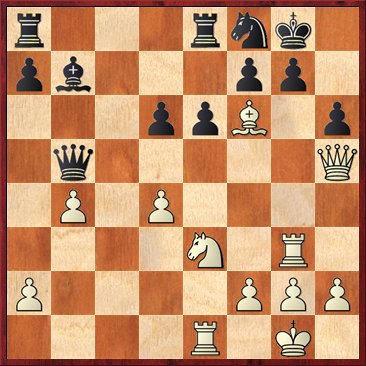
One of the most powerful and most feared weapons in chess is the discovered check.  I suspect the fear comes from the helplessness one feels as the rampaging piece does its business to destroy your position.  A extreme example of this is the “windmill” series of discovered checks from this famous game:

C. Torres Repetto-Em. Lasker, Moscow 1925

White had just played 1. Bg5-f6! uncovering an attack on the Queen, which gave Black no choice:

1…Qxh5 2. Rxg7+ Kh8 3. Rxf7+ Kg8 4. Rg7+ Kh8 5. Rxb7+ Kg8 6. Rg7+ Kh8 7. Rg5+ Kh7 8. Rxh5

 and White soon converted his material advantage.  One would not have to endure very many of these situations to develop a natural aversion to the discovered check!  But, as Reti noted, in chess we value the exception rather than the rule.  In the following examples, by reacting instinctively (fearfully) to the threat of discovered check, the opportunity to show an exception was missed.

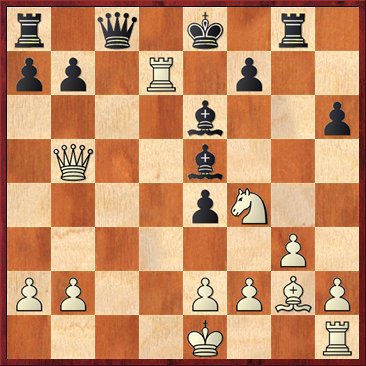
M. Adams (2751)-S. Sethuraman (2637), Gibraltar 2017

White had just captured a N on d7, expecting (due to the threat of discovered check) to pick up the now loose Be5 (and this is in fact what happened in the game.)  Later Black pointed out what both Grandmasters had missed:

1…Bxf4!!

The exquisite point being that while White can win the Queen, he will lose the game:

2. Rc7+ Bd7! 3. Rxc8+ Rxc8


and White cannot save his Queen and meet the threat of 4…Rc1+.

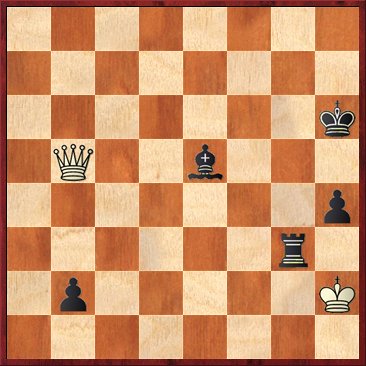
N. Vardan (2079)-M. Gomes (2302), London 2016

Black has been trying to find a way to promote the b2-pawn for over 60 moves but the lack of protection around her King has made it problematic.  She just played 1…Be5, setting up the discovered check.  White stepped out of it with the obvious 2. Kh1 and soon had to resign.  The missed opportunity was:


2. Qxe5! b1=Q 3. Qh5+!


when Black will have to acquiesce to either perpetual check or stalemate.


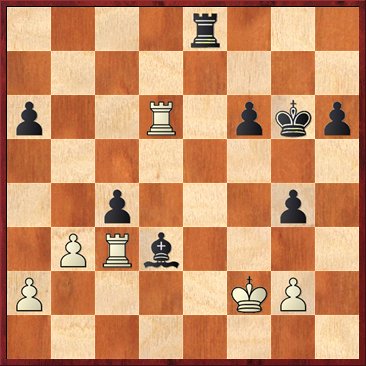
The final example is from one of my own games:

K. Jones (2213)-R. Haring Orton (1954), US Open 2016

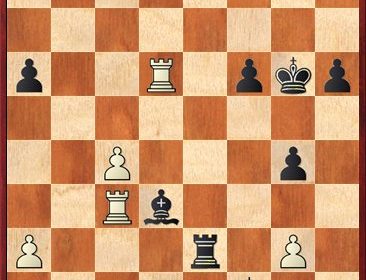
After the correct 1. bxc4! Re2+ 2. Kg3?? I was unable to win the game.  Given the theme of this article, can you see what I missed?


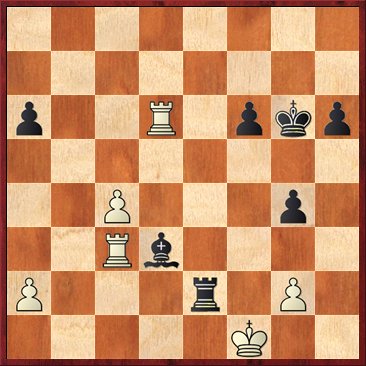
I should’ve walked into the discovered check with 2. Kf1!!

Position after 2. Kf1!!

Black’s Bishop is doubly attacked, so that after a discovered check I can capture it with one Rook while protecting the other.  Meanwhile, the Bishop cannot move away from guarding his own Rook, so it is lost anyway.


I hope this article will encourage you to look beyond the obvious in your own games!

Ray Gatten vs Ken Jones, 10th USCCC Prelim

Game and annotations courtesy of NM Ken Jones

[ctpgn layout=”left” id=GattenVsJones1990]

[Event “10th USCCC Prelim”]
[Site “?”]
[Date “1990.??.??”]
[Round “?”]
[White “Gatten, Ray G”]
[Black “Jones, Kenneth E”]
[Result “0-1”]
[ECO “E87”]
[Annotator “Ken Jones”]
[PlyCount “56”]
[EventDate “1990.??.??”]
[EventType “corr”]
[Source “ChessBase”]
[SourceDate “1999.07.01”]

{(Although this game is over 25 years old, the opening remains topical. It
also brings back fond memories; by winning it, I finished a half a point ahead
of my opponent and advanced to my first US Correspondence Chess Championship
final.)} 1. d4 Nf6 2. c4 g6 3. f3 $5 {(This was originally billed as an
“Anti-Grunfeld” variation, and is still seen at the highest levels today)} Bg7
({(Black can also go down unusual paths with} 3… Nc6) ({or} 3… Nh5 {)}) 4.
e4 O-O $5 5. Nc3 d6 {(after some side-stepping we’re back to the Saemisch)} 6.
Be3 Nbd7 7. Nh3 {(First played by Nimzovitch in 1929(!!), this move intends to
support the e4 pawn with Nf2, rather than by Nge2-g3)} e5 8. d5 Nb6 $5 {(This
is an idea of Missouri IM Mike Brooks, who showed me a few of his games with
it. [Unfortunately, I didn’t write them down!] His plan was to continue with ..
.c6, …cxd5, …Bd7, and then play for …Nc4 with either …Rc8 or …Qc7.)}
9. c5 {(There is no reason to avoid the natural 9. Nf2)} dxc5 ({(Funnily
enough, Black can still achieve his aim after} 9… Nbd7 10. cxd6 cxd6 11. Nf2
Nb6 {etc., but now there is an attract option)}) 10. Bxc5 Bxh3 $1 {(Finding
this Bishop a satisfactory assignment is often problematic in the King’s
Indian but here he gets to go out a hero)} 11. Bxf8 Bxf8 12. gxh3 Nh5 {(With
White’s K-side shattered and having better development and total domination
over the dark squares, there is little doubt that Black has full compensation
for the exchange)} 13. Kd2 $2 {(Too extravagant–White is running before he is
chased.)} c6 14. Kc2 cxd5 15. Nxd5 Rc8+ 16. Kb3 $2 ({(Occasionally one sees a
game where a bold King march is good, but here White should really slink back
with} 16. Nc3 {)}) 16… Nxd5 17. Qxd5 Qb6+ 18. Qb5 Qf6 {(Eyeing f3, of course,
but really intending the powerful Rook lift)} 19. Ka4 {(“Consistency may be
overrated as a virtue.” –Joseph Heller)} Rc6 20. b4 $6 {(This only makes it
worse–not that an acceptable alternative was available)} Rb6 21. Qc4 Rxb4+ 22.
Qxb4 Bxb4 23. Kxb4 Qb6+ {(This simple check wins material)} 24. Bb5 {(Both 24.
Ka4 & 24. Qc3 are met by Qd4+, and 24. Ka3 a5 is no help either)} a6 25. a4
axb5 26. a5 Qd6+ 27. Kxb5 Nf4 28. Rhf1 Nd3 {(Black mates in 4 moves or less,
so White resigned)} 0-1[/ctpgn]

Marty Phillips vs Ken Jones, 2016 Springfield Open

Game and annotations courtesy of NM Ken Jones. Round 4 of the 2016 Springfield Open held at Missouri State University.

[ctpgn layout=”left” id=”PhillipsVsJones2016″]
[Event “Springfield Open”]
[Site “?”]
[Date “2016.10.23”]
[Round “4”]
[White “Phillips, Martin”]
[Black “Jones, Kenneth”]
[Result “0-1”]
[ECO “E81”]
[WhiteElo “1837”]
[BlackElo “2199”]
[Annotator “Ken Jones”]
[PlyCount “46”]
[EventDate “2016.??.??”]
[Source “ChessBase”]
[SourceDate “1999.07.01”]

{(One of the best things about returning to tournament play has been
reacquainting with chess friends from many years ago. Before the start of the
tournament, I got to catch up a little with Marty Phillips; as the only two
perfect scores, we met at the board in round 4.)} 1. d4 Nf6 2. c4 g6 3. Nc3 Bg7
4. e4 d6 5. f3 O-O 6. Be3 Nbd7 {(This system surged in popularity after GM
Nunn won some nice games with it in the 1980’s)} 7. Qd2 c5 8. d5 Ne5 9. h3 {
(Intending to force the Ne5 back, but it’s not so simple. Meanwhile White
spends another tempo on a pawn move and creates another hole on the K-side.)}
Nh5 10. Qf2 ({The alternative} 10. Bf2 {led to a Black brilliancy in
Belyavsky-Nunn, Wijk aan Zee 1985 after} f5 11. exf5 Rxf5!! 12. g4 Rxf3! 13.
gxh5 Qf8) 10… f5 11. O-O-O?? ({(After the better} 11. exf5 gxf5 12. f4 Ng6 {
Black has adequate counterplay)}) 11… f4 12. Bd2 Ng3 {(Now White has no play
on the K-side and can only await Black’s assault on the Q-side)} 13. Rh2 a6 14.
Kb1 ({One problem is that after the obvious} 14. Nge2?? Nd3+ {wins the Queen})
14… Bd7 ({A good alternative is to play it like a Benko Gambit with} 14… b5
15. cxb5 Nxf1 16. Qxf1 axb5 17. Nxb5 Qb6 {with powerful threats}) 15. Bc1 Rb8
16. Bd3 Nh5 {(Not allowing White to bail out with 17. Bxf4 Rxf4 18. Qxg3)} 17.
Rd2 b5 18. Nge2 Qa5 19. Rh1? Rb7?? ({(I was so focused on a methodical
buildup that I overlooked that} 19… Nxd3 20. Rxd3 bxc4 {wins a piece
immediately:} 21. Rd2 Bxc3 22. Nxc3 Qxc3) 20. Qe1 bxc4 ({(And even here, much
more thematic would be} 20… Nxd3 21. Rxd3 bxc4 22. Rd1 Ng3! {since} 23. Rg1
(23. Nxg3 Bxc3) 23… Nxe2 24. Nxe2 Qa3 25. Qd2 Rfb8 {is crushing}) 21. Bc2 Bb5
(21… Rfb8 {also wins}) 22. Ka1 Nd3 23. Bxd3 cxd3 {(And White, seeing that
his intended 24. Nxb5 Qxb5 25. Nc3 is met by Bxc3 26. bxc3 Qb1 mate, resigned.)
} 0-1[/ctpgn]

2016 General Membership Meeting

The 2016 General Membership meeting will be held in conjunction with the Missouri Open. The meeting will be from 9:30 until 10:00 AM, prior to round 4, on December 11th, at the Chess Club and Scholastic Center, 4657 Maryland Ave., Saint Louis, MO 63108.

1 2 3